
Home » Gallery » Beautiful Dreamers » Perspective
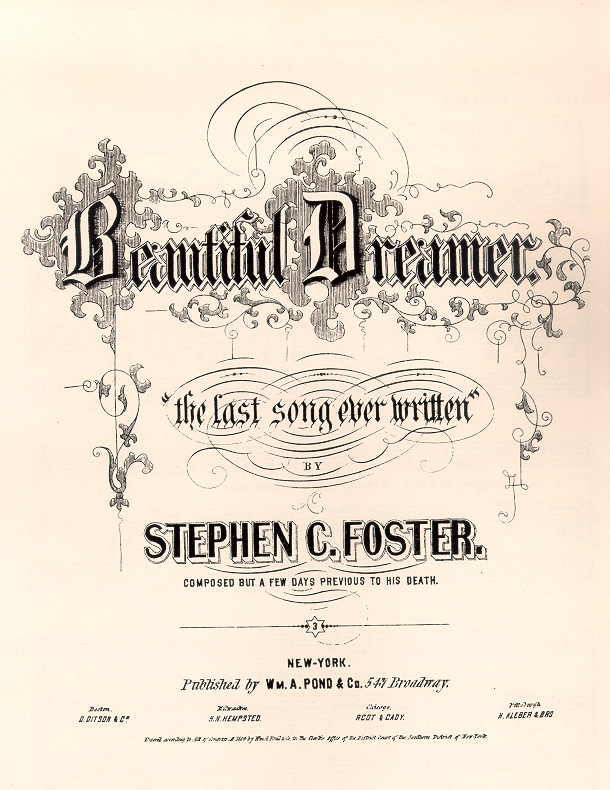
Strange Collaboration: A reflection on the artist’s process and the world.
My Childhood Roots of this Inspiration
In February when I began entering the flow of this inspiration, I welcomed Beautiful Dreamer’s gentle presence and saw its appeal during this dark time as the COVID-19 pandemic encroached into our lives. Generally the themes of my art revolve around aspects of transformation and rebirth, nature and spirit, and the divine presence in all existence. My approach to art is to navigate the creative process with sensitivity and respect, and if possible, to be a healing presence in the world — and this inspiration felt like a significant call upon my talents, so I listened.
Familiarity with Beautiful Dreamer is due to my Dad loving the song. As a teen, he told me that it was his favorite, though when pressed he didn’t know why, but that it made him feel close to God. He was spiritual man, and though this is not a religious song, I made sure to have it sung at his memorial. It wasn’t one I knew the words for, like I said, it was an old song, and not one we sang at camps, like Camptown Races or other old time songs. I’d had the basic childhood education and been introduced to Stephen Foster’s music, but as the teen years gave way to rock ’n roll and the folk music of the 60’s and 70’s, I forgot most of what I’d learned about him. But, the memory of Beautiful Dreamer had a warm place in my heart.
A New Awareness of Culture’s Ills Surfaces
Life had taken a unique cultural turn with the onset of the pandemic — altering our pace to slow us down, reducing environmental noise, clearing the air we breathe, forcing isolation — almost imposing a state of introspection upon a materialistic and self-absorbed culture. For most of society who were not front-line workers, this silver lining of a dreadful pandemic was recognized by many.
Into this fertile ground in May, ripe for new perspective, invaded a horrific video depicting the murder of George Floyd at the hands of the police. And then more deaths by excessive police force followed; forcing open everyone’s eyes to the injustices that have always been. Understandably, that shocking video of a white officer kneeling on the neck of a Black man for nearly nine minutes until he died, seen by all, compelled an intense reaction toward issues of race and history in America — and a greater desire to shed the persistent practices of the toxic past. The Black Lives Matter movement that formed seven years ago in response to police abuse has now ripened; thousands of allies have joined in the cause in an effort to finally turn the tide.
The pandemic itself has catapulted the sharp economic disparities in the United States into harsh visible contrast. It reveals that the hardest hit are the poorest citizens and essential workers interfacing with the public who can’t afford to isolate themselves for their safety. And, systemic racism underlies these economic structures. The solitude and perspective gained in the early months of the pandemic fueled a momentum that could rise, not only in response to police abuses, but also in response to a pivotal election year. Over the summer, protests both peaceful and violent have erupted as people are trying to find their way toward substantive change.
Culturally, we are in a polarized and impatient time in which the popular stance is a Cancel Culture response to offenders, living or dead. The voices of the masses are causing prominent contemporary figures to topple due to their past sexual or racial misconduct, while historical statues are physically brought down by the masses when local governments haven’t been proactive enough. Everyone is frustrated, and it’s high time for change to happen. The cleansing of the public square necessitates the removal of Confederate statues that were installed in the Civil Rights Era to prop up white supremacy, and yet, recently, even a statue of Lincoln fell. It can seem like there is no space for balance or redemption while absolute clarity is sought. It is a confusing and creative time on all levels.
Reflecting Back Upon My Inspiration
Though my Beautiful Dreamers art project seemed perfectly lovely at inception, early on I began to wonder whether the song, Beautiful Dreamer, carried an association that would limit the ability of this project to evoke the gentleness and healing that’s needed. I needed perspective on whether Stephen Foster is controversial at this point in time and if the burden of Beautiful Dreamer’s pre-Civil War origins would cast a shadow over it. Art is always a mirror to the artist, and I couldn’t look away from that concern. The journey of this piece would take me into history, and I recognized that in looking into the song’s origin and learning about Stephen Foster, I would also be cultivating a new awareness for myself about the present and the past in regard to racial issues and the purpose of art.
So, What About Stephen Foster?
As I sought out perspective on Stephen Foster and his legacy, I learned that scant personal information is known about him. Therefore, his work must speak for himself too. We know that he was a Northerner writing naïvely about the South, his dreamy perspective about places he never visited had a popular appeal. Though a small minority of his lyrics were offensive or views of the lives of slaves misleading — it’s important to recognize that he also humanized African-American slaves and presented them in a good light, and that the vast majority of his songs had no race component at all. It also matters that he was an abolitionist who advocated for the rights of Free Blacks to serve as soldiers in the Civil War.
While it’s understandable that some will not appreciate a song as innocuous as Beautiful Dreamer, simply because he wrote it, it’s important to recognize that Stephen Foster is regarded as the father of American popular music. His melodies hold up after 200 years time, with many of his songs still beloved, sung, and recorded. He’s therefore impossible to erase, and that is an example at the crux of this broader social dilemma.
The desire to thwart racism brings the need to root out various influences that enable it to persist. Some feel that all of Stephen Foster’s work is inextricably linked to a pre-Civil War era of legalized racism, slavery, and abuse. And, frankly, because he misrepresented slave’s lives and wrote lyrics that we find horribly offensive now, some of his work should be left to the past!
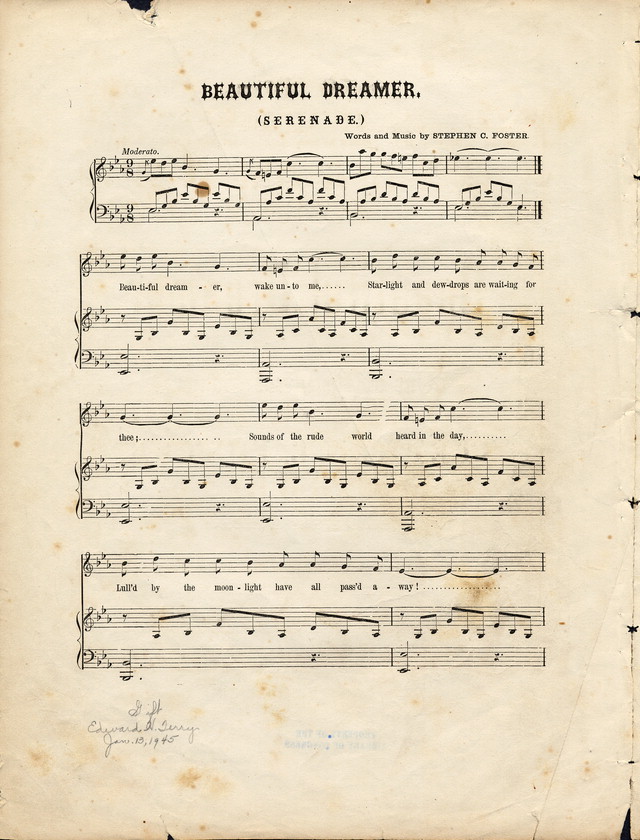
From my perspective, Foster was a mixed bag — a flawed artist who was highly prolific, one who became successful, only to die a young penniless drunk at the age of 37. There’s not much documented about him personally, and this may imply that his family found him to be a troubling sort. He was talented, ambitious, and often intoxicated. He was the first popular songwriter who actually tried to make a living doing it, which meant that he probably had to make a lot of compromises to survive. A composer of over 200 songs, his early work, some 20 songs, were used in minstrel shows, often with performers in blackface. As America’s first full-time professional songwriter, he was taken advantage of by the music industry of his day; barely rewarded for his wildly popular songs. He also had no control of how offensively the minstrel shows or sheet music printers portrayed his tunes. (Because of the abuses he suffered at the hands of the music industry, protections for songwriters later came into being.)
It appears that he started out pretty naive, about the South, about enslaved people, but grew in his perspective over time to become more conscientious in his writing and critical of slavery. He was innovative, incorporating different cultural sounds into his craft, a world musician of sorts. And while I may not have liked him personally, I can appreciate him generally as an artist; and as an artist I can also see the artist, the personality, and the work as separate things. It is easy for me to relegate the offensive work to the past, and to only elevate into modern times the songs that fit harmlessly into the culture of this era, and to let his flawed personality rest in peace.
Knowing this Now, Where do I Stand?
I stand with racial justice, I stand for the arts, I stand for freedom in expression and social responsibility; this is nothing new. Yet based upon what I’ve learned, I believe that some of Stephen Foster’s work should be left to the past, or at the very least, lyrics transformed for use in the present day. Respect for the people of today is more important than preserving the authenticity of lyrics rooted to the racist past. I believe that there needs to be space for the appreciation of excellence, even if brought forth by flawed people who are no longer in a position to cause harm. We need to be able to acknowledge our full history. We need to be able to share our viewpoints and discuss the merits of them, to listen to each other and learn from each other — only then will we be able to collaborate together on a better future.
The Influence of an Odd Love Song
Given this complex social backdrop and its critical lens, the easiest thing for me to do would be to swap out the song, however, I never seem to take the easy route with my work. The creative challenge is that Beautiful Dreamer just arrived along with the inspiration — it’s not like I thought about how to use that song in a piece. Instead, only knowing the opening lines, I looked up the lyrics and was amazed that this art project about Sheltering-in-Place and people dying in isolation, came with the perfect pairing of image and title. While I didn’t know anything about Stephen Foster before, I’m rather amazed by his achievements with this composition, and Beautiful Dreamer is regarded as one of his greatest works.
While Beautiful Dreamer is an odd love song, I believe it’s actually a metaphor of divinity singing the mortal beloved across the threshold of death. This interpretation of Beautiful Dreamer fits the art piece perfectly, and consequently it isn’t so easily swapped out with another song or poem, though I did try. There’s a lot of trust involved in being an artist, in trusting inspiration, and because of this I’ve chosen not to shed the song from this work.
More Perspective from a Playwright and an Historian
As an artist I seek to be true to inspiration, and yet, it’s my responsibility to guide the work successfully into the world, in ways that can more likely be a healing balm than an inflammatory presence. In my research, I’ve taken heart in the various projects that others have produced in recent years that focus Stephen Foster into a contemporary expression fitting for this point in time, especially the 2018 play, Paradise Square: A New Musical, written by Marcus Gardley, Craig Lucas, and Larry Kirwan.
Set in the 5-Points region of New York during 1863, just prior to the Civil War, poor Irish immigrants and African American immigrants, lived, worked, married, and found harmony among each other — until the outbreak of the Civil War shattered the peace they’d created. This musical reformed and reframed Foster’s music to show the inspiring nature of his contributions, and featured a large cast of African American and white actors collaborating in music and dance.
Further, Ken Emerson wrote in Stephen Foster & Co.: Lyrics of the First Great American Songwriters, (2010) “Although some of Foster’s blackface lyrics are abhorrent… at their best they imbue African Americans with a dignity and pathos that were unprecedented. No songwriter had called a black woman a lady before Nelly Was a Lady. Unbeknown to most of the throng that sings bowdlerized lyrics on Derby Day, My Old Kentucky Home does not celebrate cavaliers and crinolines in the Old South — it invokes Uncle Tom’s Cabin and indicts slavery for breaking up black families.” There’s just no singular way to view Stephen Foster, which is true of historically great artists… they’re simply not saints.”
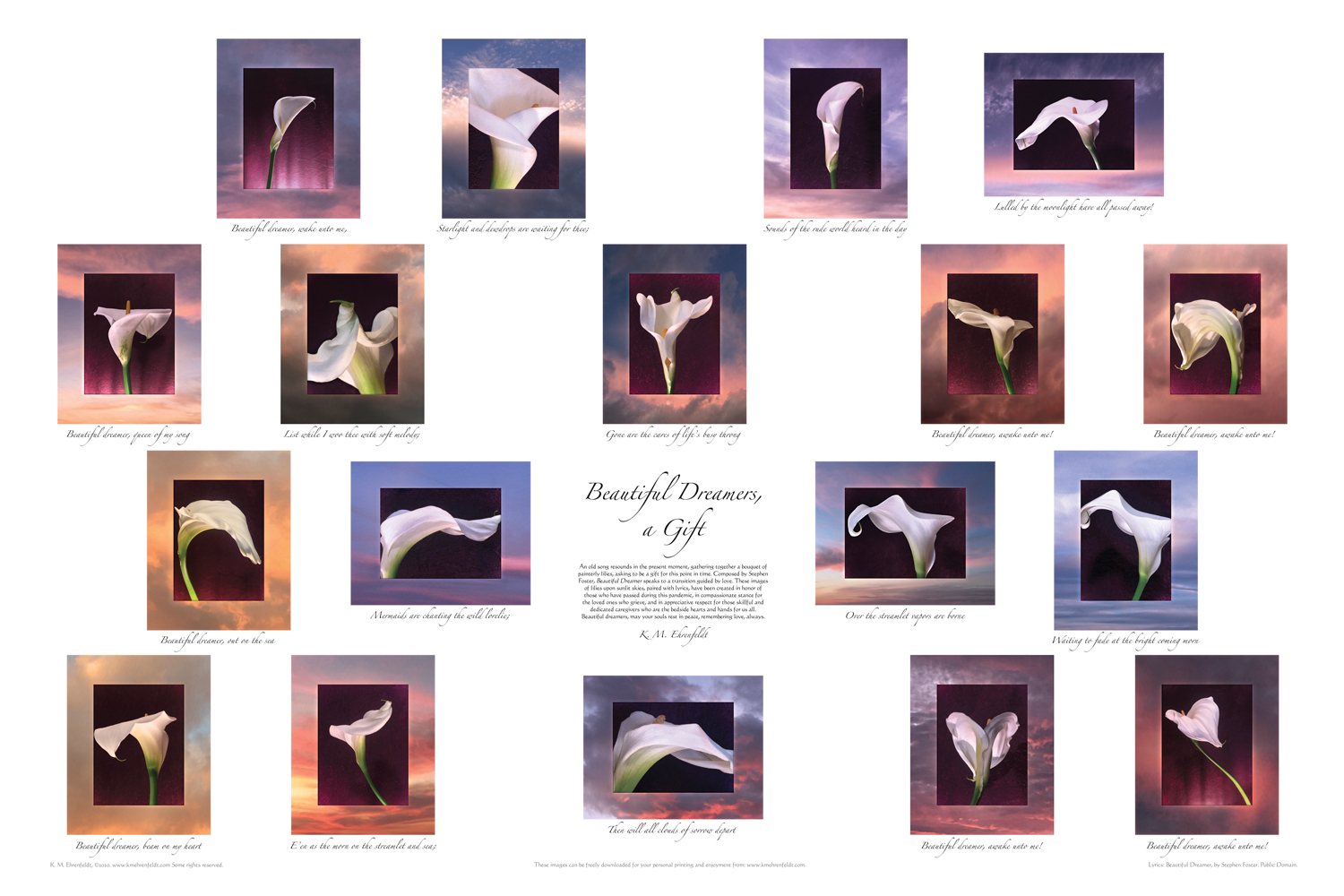
Beautiful Dreamer (Lyrics)
Making Peace with this Strange Collaboration
Inspiration has put forth Beautiful Dreamer for this project of mine, and I’ve had to learn about Foster and confront how I feel about him, making this a very strange collaboration. It’s some relief to me that Beautiful Dreamer may have been the last song composed by him, and to know that it was published posthumously means that it was always isolated away from the earlier minstrel performances. As I waded through research, to a newscast soundtrack of current events, I realized through that din and roar that there would be no consensus of opinion, no comfort coming in this process, other than what I make peace with, myself.
Given what I’d learned, once I decided to move forward with Beautiful Dreamer intact, I revisited the original perspective of the moment of inspiration — of the world as it had temporarily quieted down at the start of the pandemic… In my journal I’d written, “We breathe, cultivating what peace may be in this collective moment when the “sounds of the rude world heard in the day, lulled by the moonlight have all passed away.”
I can only hope that the beauty and gentleness of this project reaches those who will benefit from its healing nature. And, that as time goes on, our society continues to heal and grow into a greater expression of social justice and respect for all living beings.
K. M. Ehrenfeldt
10/28/2020